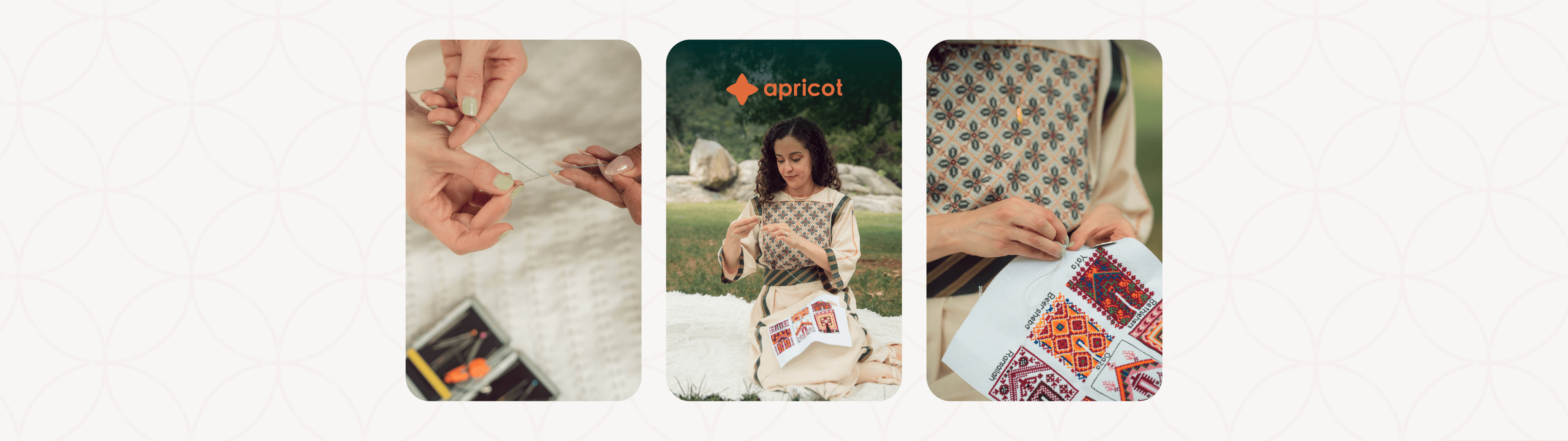
Lina Barkawi did not set out to build a brand. When she founded Lina's Thobes, she had one thing in mind: a community gathered around a legacy too important to lose.
Lina's Thobe is an educational community built around Tatreez — Palestinian embroidery, the centuries-old craft that Palestinian women have used as a form of storytelling, stitching the histories of their villages, their land, and their people into fabric of their national dress, the Thobe. Lina teaches this craft through workshops and online courses, and her mission is both deeply personal and broadly cultural: to bring more Palestinians and Palestinian allies into the practice of Tatreez, and to imagine what this craft can look like in a liberated future.
"My goal through Lina's Thobe is helping us continue that tradition and helping others tap into it in their own way."
Lina explains
With that kind of mission, the way she tells her story matters just as much as the story itself.
The vision behind the YouTube channel
Tatreez is profoundly visual. The motifs carry meaning. The colors hold history. The act of stitching is meditative and intentional. Lina knew early on that video was the right medium for taking her message further beyond tutorial content.
She wanted her YouTube channel to do something that hadn't really been done before in this space. Not just document Tatreez as a relic of the past, but reimagine it as a living practice. One that could reflect the present and reach toward the future.
The only problem was that Lina is a one-woman business. She handles customer service, product design, packaging, emails, and everything in between. Video editing was the one thing she couldn't stretch herself to do. So she decided to find someone who could. And that decision led her straight to Apricot.
How Apricot came into the picture
Lina is a member of Entrepreneurs for Palestine, and like many of its members, she stays active in the community's Signal group. It was there that she kept seeing messages from Brandon, who runs Apricot, about the platform's mission to help companies hire talent from the MENA region.
"I had seen his messages before but hadn't really thought about it," Lina recalls. "Then when the idea of hiring a video editor came to me, I remembered his posts and reached out through the website."
From there, things moved quickly. She connected with Amanda and Rawan at Apricot and walked them through her vision and the mission behind it all. They listened, and got to work. Within no time, Apricot had curated a shortlist of incredibly talented video editors, their CVs and portfolios for Lina to review.
What followed was a process she describes as genuinely thoughtful and surprisingly smooth. Lina interviewed a few of the candidates, but she wasn't just evaluating technical skill, she was looking for someone who could understand the weight of what she was building and someone who got it.
Meeting the editor who exceeded every expectation
One of those candidates was Noor. By the end of their first interview, Lina already knew she didn't need to speak to anyone else.
Noor came with a strong video editing background and a real passion for documentary storytelling. What tipped it, though, was personal. Noor's mother practices Tatreez. She grew up around handmade things — friendship bracelets, her mother's craft and she understood, instinctively, what Lina was trying to do.
At the time of their interview, Noor was displaced in Gaza. The connection was poor, and she kept apologizing for it. Lina told her not to worry. That was the reality, and they both knew it.
In those early weeks, Lina didn't even have footage ready. She had ideas, scattered Instagram clips, and interviews she'd done online. Noor took those fragments and built something beautiful.
"I remember thinking it was incredible that she was able to build something so beautiful when I gave her almost nothing to work with," Lina says.
As the collaboration deepened, so did the work. Lina wrote scripts, filmed more content, and Noor showed her what she was truly capable of. The YouTube channel grew from roughly 100 subscribers to over 1.2k in just six months. But the numbers, while impressive, aren't the whole story.
Noor isn't just the person who edits Lina's videos, she is a thought partner, a creative ally, and a friend. She asks strategic questions. She challenges ideas productively. She brings her own creative perspective into the process, shaping raw concepts into content that feels intentional and alive. All of this while navigating displacement, electricity shortages, and walking distances just to reach a workspace where she can charge her laptop.
“There’s honestly no way I would have found her without Apricot.” Lina admits, contentedly.
A message to companies thinking about hiring through Apricot
Lina didn't hesitate when asked what she'd say to other companies considering Apricot. Her answer came naturally, from lived experience.
"The talent is 100% there. In the Middle East, there is so much talent. You're not just hiring someone, you're building relationships with people. And those relationships are really important. It's not a transaction. This is about hiring someone who believes in what you're working on. And they will show up because they do, and they're going to invest themselves into the work because you're giving them a chance."
That's what Apricot is building, not a marketplace, but a bridge. For Lina, crossing it meant turning ideas that lived only in her head into a YouTube channel the world can now watch, feel, and keep coming back to.
By:
Fatima Ahmed