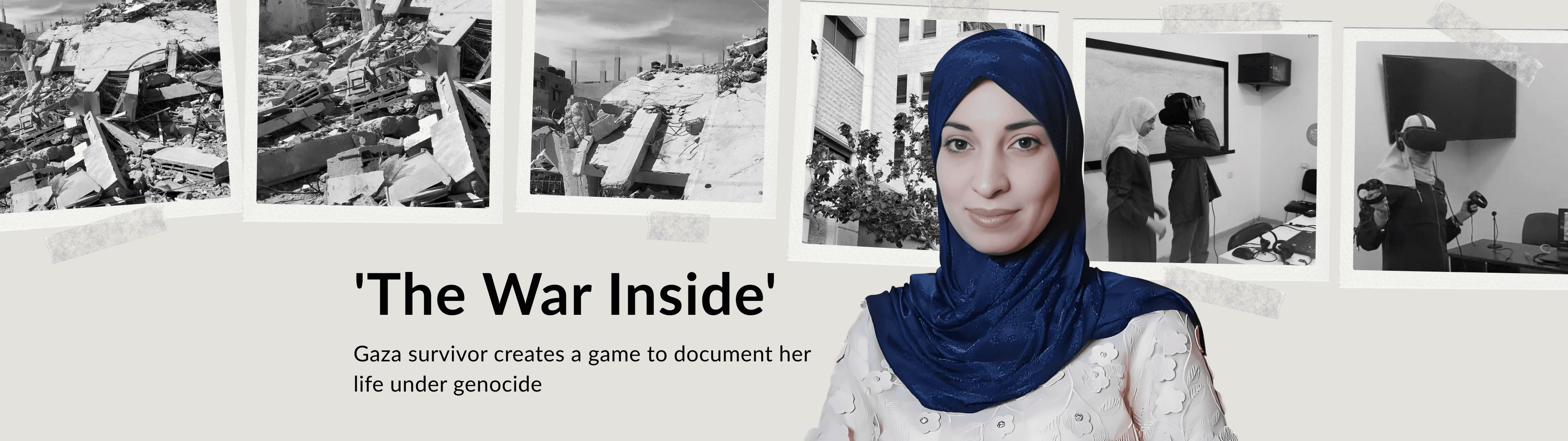
Before she was forced to confront a very different reality, Doaa Ghandour’s work had already distinguished her in the field.
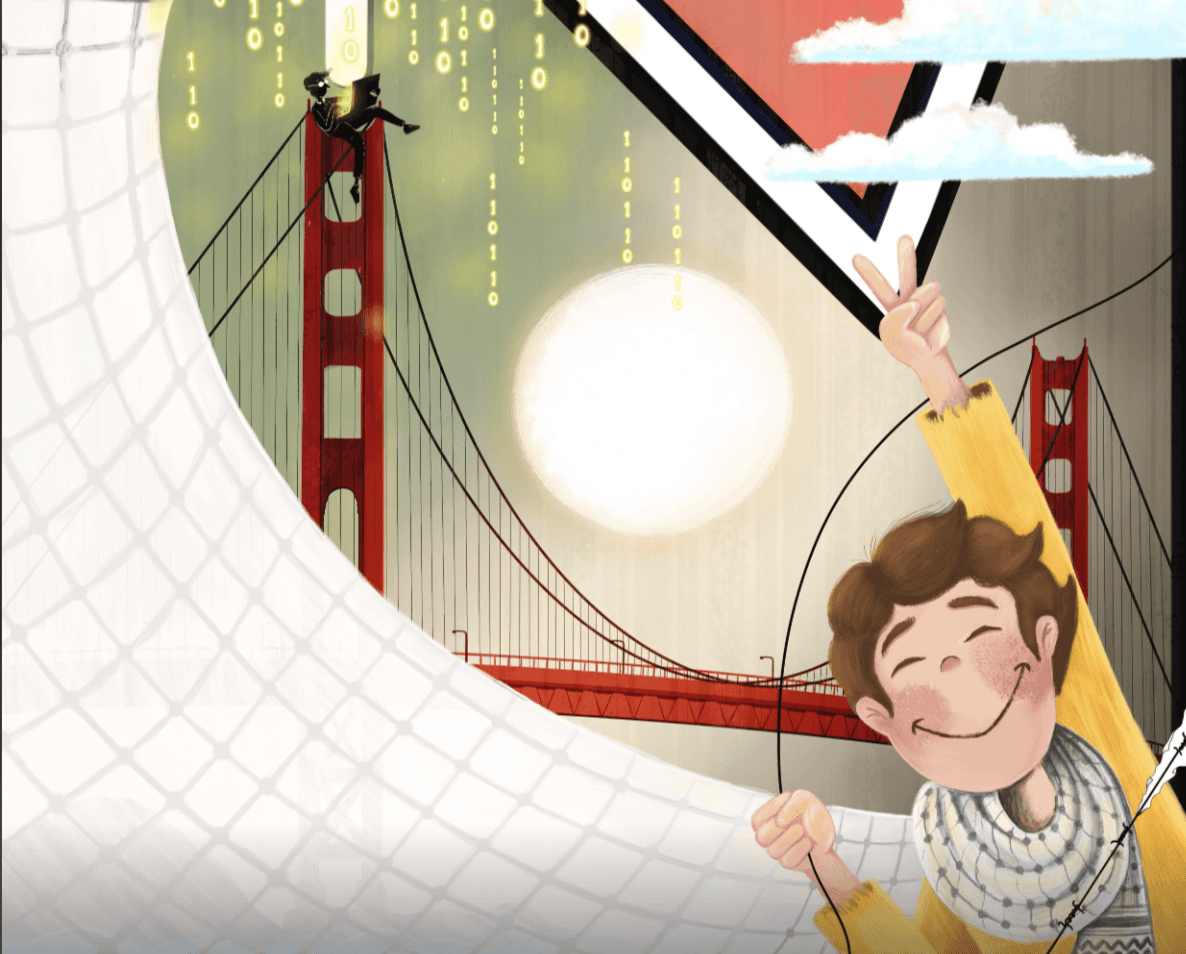
Her career in game development includes several notable milestones: an award-winning educational game about COVID-19, participation in a Silicon Valley mentorship program, and collaboration on an indie project inspired by Tony Hawk but rooted in life in the West Bank.
Reaching these achievements wasn’t a linear journey. There were periods when Doaa questioned whether she wanted to stay in the industry at all. Those doubts became especially heavy after an Israeli drone strike took the lives of most of her family. She later shared that she woke up after the attack confused and unable to piece together what had happened.
But, in the middle of that loss, she found a sense of direction. She felt she had survived for a reason and wanted to use her work to show how these events shape people’s lives.
This idea became the starting point for her upcoming game, The War Inside.
The following interview, conducted over a call, traces Doaa’s path in game development and the experiences that continue to influence her work.
Discovering a different path
Doaa Ghandour didn’t grow up playing video games. Her earliest connection to them was watching her brothers play, never picking up the controller herself.
“That made things harder when I started building games,” she said, referring to her unfamiliarity with actually playing games.
“In my early days, I didn’t even know the right timing to jump, so I would test a level dozens of times, sometimes even stopping the part of the code where the enemy kills the player just so I could test jumping while learning development.”
That process taught her how essential player experience is, something she noticed her gamer colleagues naturally carried.
Before entering game development, Doaa worked briefly as a database developer at a municipality. On the same day she opened her first bank account, the employee helping her casually mentioned he had worked there for seventeen years. The thought unsettled her; she couldn’t imagine spending years doing work that didn’t reflect her own ambitions. At the time, those ambitions weren’t tied to games yet; she simply wanted to build something of her own.
From startup dreams to game development
This led her to a startup boot camp, where she explored an idea to teach Arabic to Arab expatriate children. Market research revealed that a mobile game would be the most effective medium, pushing her toward learning game development. She spent over a year working with a small team until they encountered a common barrier for developers in Gaza.
“No one wants to put their money into Gaza,” Doaa said, smiling in a way that acknowledged both the truth and the frustration behind it.
Unemployment had already been rising for years, beginning in 2006, after the occupation authorities imposed a siege on Gaza following the Palestinian elections. From that point onward, foreign investment sharply declined, and economic conditions worsened.
Without money, in an expensive medium like game development, the team eventually packed their things and looked elsewhere for “real jobs.”
Doaa stayed, continuing to develop her skills. In 2016, she was accepted into a mentorship program in Silicon Valley, but she couldn’t travel due to the ongoing siege, which kept Gaza’s borders closed. When the organization tried again the following year, the situation remained unchanged, and the opportunity slipped away.
Still determined, she joined a colleague on a new project focused on teaching children critical thinking skills. But once again, funding became an insurmountable obstacle.
Around this time, Justin, a well-known figure in the indie game community, was searching for a Palestinian game developer and found Doaa on LinkedIn. Impressed with her work, he invited her to collaborate on the Palestine Skating Game, which soon gained a small but dedicated audience.
The war that shattered her world and sparked the making of The War Inside
For a moment, it seemed like life was opening up. Then, in 2023, the war began.
The bombings in Gaza took the lives of Doaa’s parents, brother, sister, and sister-in-law. She and her younger sister, Nour, were the only immediate family members able to escape. Three of her remaining siblings remain in Gaza.
Even in the midst of overwhelming grief, Doaa had to think about her remaining family, so she began taking steps toward rebuilding her life.
Her mentor from TechWomen introduced her to Apricot’s founder, Brandon, who wanted to help her secure work. Instead, he encouraged her to create a game for Palestinian children and offered support in making that possible.
The war pushed Doaa even further toward using her skills for her community.
With Apricot helping her access the resources she needed, her early ideas began to grow into her next project The War Inside, now in development.
How The War Inside was shaped by surviving in Gaza
The War Inside is a 2D exploration game that follows a young boy living through the genocide in Gaza, showing both his daily reality and the nightmares shaped by what he witnesses. The story opens with him standing at his window, watching people outside fill their water gallons and charge their phones at a small solar-powered station. Suddenly, a bomb hits the building next door. The shockwave tears through his home, and shattered glass from the window injures his face and hands. From this moment, the narrative splits between his waking world and the nightmares that follow.
Doaa’s approach to the game was mainly inspired by games Inside and Gris, especially in how they use art and color to express emotion. She chose a third-person perspective to portray Palestinian life with accuracy and care. Details matter to her, even small ones, such as keeping characters’ hair short to reflect how people in Gaza keep their hair short to conserve water while showering during the genocide
Although the setting is shaped by violence, the characters in the game never carry weapons. This is intentional.
“I want to tell people what the weapons do,” she said, talking about the destructive role they play in Gaza, “How it affects people’s lives...weapons are the worst thing in the world. I want people to know about how we really suffer here, when the camera turns off, how it goes with people.”
Much of the game draws from Doaa’s own memories and nightmares of the war. Writing it often meant returning to moments she wished she could forget, which is why she describes The War Inside not as a war game, but as a memory game.
She designed it for two audiences. For players outside Palestine, it offers a way to understand what the genocide looked and felt like for those living through it. For Palestinians, it aims to provide a small tool for processing trauma; therapists have supported parts of its development to ensure it can serve that purpose.
Doaa hopes the game will stand as a record. When the headlines fade and time moves on, she wants people to still have a place where they can learn what happened and feel the human story behind it.
Game development as a form of resistance
Palestinian storytelling has long been expressed through film, literature, and poetry. Games, however, are still a newer and less recognized form of resistance. The local game development community is small, challenged by limited resources, unreliable electricity, and a common belief that games aren’t a serious medium for social impact.
Even so, this perception is beginning to change. Developers like Rasheed Abueideh, known for Liyla and the Shadows of War and his upcoming game Dreams on a Pillow, have shown that games can carry powerful messages. Projects like Justin’s Palestine Skating Game, which Doaa contributed to, add to this growing space.
Doaa believes games can reach people in a way other media cannot.
“Games, they are interactive. When you lose, you lose,” she said.
“In a movie you can just watch the hero go through the story, and if he dies, yes it’s a little sad, but it just goes on. Games, they go deeper because of the feeling you have with the character, the music, the atmosphere, all of that makes a connection with the user that other stories can’t do.”
What keeps her moving
Despite everything she has endured, Doaa is clear about how she wants to be seen.
“This is my way, and I have a clear conscience that I have to do something, and I’m not a victim.”
For her, game development is a form of resistance, not entertainment for its own sake. Many of her projects focus on helping children, and she continues to carry the memory of her family with her, especially her father, whose encouragement still guides her.
“He was really supportive of me,” Doaa recounted, holding back her emotions, “...He said, just, just do what you want to do, what you're passionate about. That’s the main reason I have this job.”
During COVID-19, that motivation surfaced again when her sister, who was 11 at the time and has Down syndrome, sincerely asked her why she couldn’t “kill the virus” with all her tech skills. She genuinely believed Doaa could stop the virus, so she could go outside again during quarantine. The question moved Doaa deeply and led her and her partner to enter a local hackathon, where they created a game to help children understand safety measures and feel less afraid. The game went on to win first place in the tech-a-thon.
It became another moment when, just as she was on the verge of stepping away from tech, something pulled her back toward the path she was meant to follow.
Carrying the story forward
The War Inside is now in pre-production, with Doaa leading its narrative direction. Several respected developers have stepped in to support the project, confident in the clarity and purpose behind her vision.
For Doaa, the goal has never been commercial success. Her work is a way to record the reality she and millions of Palestinians live each day so that those outside their world can understand it. Creating this game is her way of honoring her family, her community, and the memories she refuses to let disappear.
And if the game needs time to grow, she isn’t worried.
“We’ll just make it a little better, and a little better, and keep trying until it is good.”
Until then, she leaves us with this line from the third chapter of the Quran, which formed the basis behind the name of her studio, Bayan, and is fitting for what her game hopes to accomplish.
“This is a clear statement to mankind, a guidance and an admonition to the pious.”
To support Doaa, you can follow her work on LinkedIn and keep an eye out for the upcoming fundraising campaign for The War Inside.
By: